

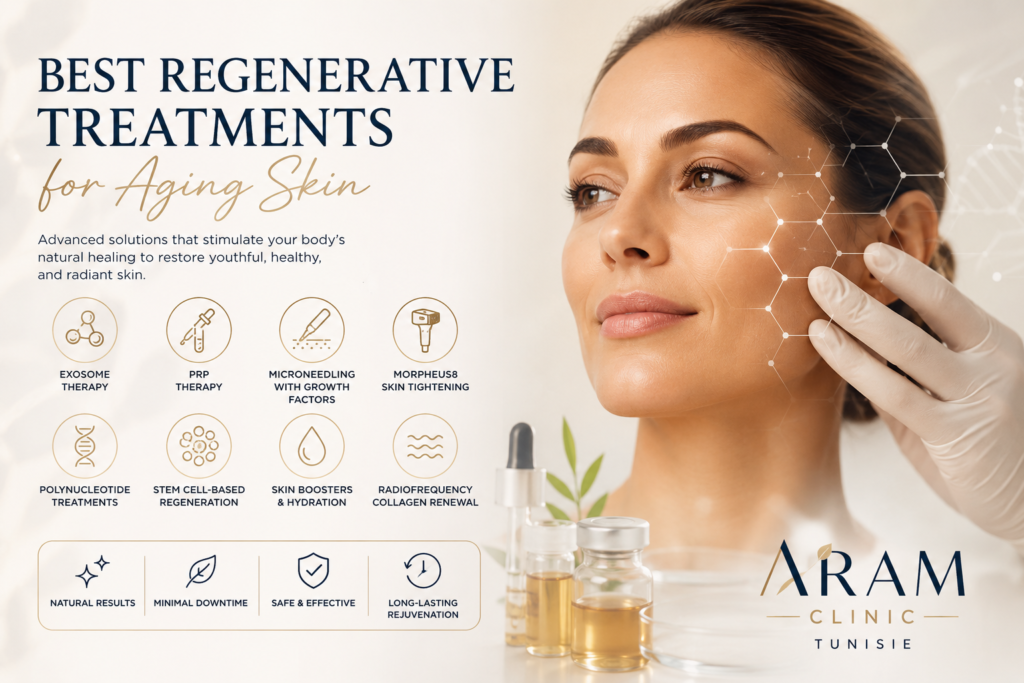
Regenerative Treatments for Aging Skin: Exosomes, PRP, Microneedling & More (2026 Guide)
Quick Answer
Regenerative aesthetic medicine treats aging skin by stimulating the body’s own repair processes rather than masking wrinkles. The main options in 2026 are exosome therapy, PRP, microneedling, Morpheus8, polynucleotide injections, and skin boosters. Each works by triggering new collagen and elastin production; the best choice depends on skin condition, degree of laxity, and desired downtime.
What Is Regenerative Aesthetic Medicine?
Regenerative aesthetic medicine is a category of non-surgical treatments that use biological substances and energy-based devices to trigger the skin’s own repair mechanisms, rather than temporarily masking wrinkles or tightening tissue from the outside. These treatments prompt the body to generate new collagen, elastin, and healthy skin cells.
Typical goals of regenerative treatment include:
- Improving skin texture
- Reducing fine lines and wrinkles
- Restoring elasticity
- Increasing hydration
- Enhancing radiance
- Slowing the visible aging process
Most regenerative procedures require little to no downtime and produce gradual, natural-looking results rather than an immediate, artificial change.
Why Does Skin Age?
Skin aging is the visible result of declining collagen production, reduced elastin, lower hyaluronic acid levels, slower cell turnover, and cumulative UV and pollution exposure.
These underlying changes lead to:
- Wrinkles and fine lines
- Sagging or crepey skin
- Volume loss
- Uneven tone
- Dull complexion
- Enlarged pores
Regenerative treatments are designed to address these root causes rather than only the visible symptoms.
Exosome Therapy
Exosome therapy is a regenerative treatment that uses naturally occurring extracellular vesicles released by stem cells to deliver growth factors and signaling molecules directly into the skin, stimulating collagen and elastin production.
How it works: Exosomes carry proteins, peptides, and genetic material that help skin cells communicate and regenerate. Applied topically or via microneedling, they trigger tissue repair and reduce inflammation.
Reported benefits:
- Improved firmness
- Smoother texture
- Reduced wrinkles
- Better hydration and tone
- Faster healing after other procedures
Best candidates: Patients with early signs of aging, sun-damaged skin, fine lines, or mild skin laxity.
Exosomes vs. PRP: Exosomes generally contain a higher concentration of regenerative signaling molecules than PRP, which is why many practitioners consider exosome therapy a stronger or faster-acting option — though clinical comparisons are still an active area of research.
PRP (Platelet-Rich Plasma) Therapy
PRP therapy is a regenerative treatment that uses a concentrated preparation of the patient’s own blood platelets to stimulate collagen production and tissue repair.
How it works: A small blood sample is drawn and processed to isolate growth-factor-rich plasma, which is then injected or applied to the skin.
Reported benefits:
- Uses the patient’s own biological material, minimizing allergic reaction risk
- Improved skin quality and circulation
- Reduced fine lines
- Better overall texture
Microneedling with Growth Factors
Microneedling is a collagen-induction technique that uses fine needles to create controlled micro-injuries in the skin, triggering the body’s natural wound-healing response and new collagen formation.
Reported benefits: Improvement in fine lines, wrinkles, acne scars, enlarged pores, and uneven texture.
Combined protocol: Pairing microneedling with exosome or PRP application is a widely used approach, since the micro-channels created by the needles allow regenerative material to penetrate more deeply into the skin.
Morpheus8 (Radiofrequency Microneedling)
Morpheus8 is a regenerative skin-tightening treatment that combines microneedling with radiofrequency energy to remodel collagen in the deeper layers of the skin.
Reported benefits:
- Skin tightening
- Wrinkle reduction
- Improved jawline definition
- Reduction of crepey skin texture
Treatment areas: Face, neck, jawline, under-eye area, décolletage.
Best candidates: Patients with mild to moderate skin laxity.
Polynucleotide Treatments
Polynucleotide therapy is a regenerative treatment that uses purified DNA fragments, injected into the skin, to stimulate tissue repair and long-term hydration.
Reported benefits: Improved elasticity, deeper hydration, increased collagen production, reduced inflammation.
Common treatment areas: Under-eye region, neck, hands — areas where the skin is thin and prone to early aging signs.
Stem-Cell-Derived Products
Stem-cell-derived regenerative products are formulations developed from stem-cell technology (rather than direct stem-cell injection) that support cellular repair and collagen synthesis.
Regulation of direct stem-cell treatments varies by country, so most clinics — including those in the EU and Tunisia — use stem-cell-derived products rather than live stem-cell injections.
Reported benefits: Enhanced cellular repair, increased collagen synthesis, improved skin density.
Skin Boosters (Hyaluronic Acid Regeneration)
Skin boosters are injectable hyaluronic acid treatments designed to improve skin quality from within, rather than add volume like traditional dermal fillers.
Reported benefits: Deep hydration, increased elasticity, improved glow, reduction of fine lines.
Common treatment areas: Face, neck, hands, décolletage.
Radiofrequency Treatments
Radiofrequency (RF) treatments use controlled heat to stimulate collagen remodeling in the deeper skin layers. Common RF-based procedures include Morpheus8, BodyTite, FaceTite, and AccuTite.
Reported benefits: Tightened skin, improved contours, reduced wrinkles, with results that continue to improve for several months after treatment.
Comparing Regenerative Treatments
| Treatment | Mechanism | Best For | Downtime |
| Exosome therapy | Growth-factor signaling molecules | Early-to-moderate aging, sun damage | Minimal |
| PRP | Patient’s own platelet growth factors | Early aging, natural approach | Minimal |
| Microneedling | Controlled micro-injury | Texture, scars, pores | 1–3 days |
| Morpheus8 | Microneedling + radiofrequency | Mild-to-moderate laxity | 3–5 days |
| Polynucleotides | DNA fragment injections | Hydration, delicate areas (under-eye, neck) | Minimal |
| Skin boosters | Hyaluronic acid | Hydration, glow | Minimal |
| Radiofrequency (RF) | Controlled heat | Skin tightening, contouring | 1–3 days |
Combining Treatments
Regenerative medicine protocols increasingly combine therapies rather than relying on a single procedure:
- Exosomes + microneedling — intensive cellular regeneration with collagen stimulation
- PRP + microneedling — a widely used approach for texture and fine lines
- Morpheus8 + exosomes — combines skin tightening with cellular regeneration
- Skin boosters + exosomes — combines hydration with renewal
A personalized plan, built after a consultation with a qualified practitioner, generally produces more natural and longer-lasting results than any single treatment alone.
Which Regenerative Treatment Is Best for Your Age and Skin Condition?
| Stage | Recommended Treatments |
| Early signs of aging | PRP, microneedling, skin boosters |
| Moderate aging | Exosome therapy, Morpheus8, polynucleotides |
| Advanced aging | Combination regenerative protocols, radiofrequency, exosome-based programs |
The right treatment depends on age, skin condition, degree of laxity, wrinkle severity, lifestyle, and desired outcome — a consultation with a qualified aesthetic specialist is the only reliable way to determine the best strategy for a given patient.
Regenerative Treatments in Tunisia: What to Know
Tunisia has become a well-established destination for aesthetic medicine and medical tourism, offering modern clinics, experienced practitioners, and lower treatment costs than many European or North American countries. [ Find out more about the regenerative medicine treatments offered by our surgeons at Aram Clinic in Tunisia.]
At Aram Clinic Tunisia, patients can access : e.g. “exosome therapy, PRP, and Morpheus8“, delivered by Dr Youssef Gam, as part of a personalized care plan that includes consultation, aftercare, accommodation, etc.
Frequently Asked Questions
Is exosome therapy safe?
Yes. When performed by experienced medical professionals using premium-quality exosome products, exosome therapy has an excellent safety profile. The treatment is minimally invasive and is generally well tolerated, with most patients experiencing only mild, temporary redness or slight swelling at the treatment site that resolves within a few hours or days.
At Aram Clinic Tunisia, patient safety is our highest priority. Every treatment begins with a comprehensive medical consultation to determine whether exosome therapy is appropriate for your needs. We use carefully selected exosome products that meet strict quality standards and follow rigorous treatment protocols to ensure the highest levels of safety and care.
While exosome therapy is one of the most promising innovations in regenerative aesthetic medicine, its success depends on the quality of the product and the expertise of the medical team performing the procedure. That is why choosing a reputable clinic with experienced practitioners is essential.
Our goal is to provide patients with advanced regenerative treatments in a safe, controlled, and professional environment, helping them achieve natural-looking skin and hair rejuvenation with minimal downtime and maximum confidence.
How long do results from PRP or exosome therapy last?
The longevity of results depends on the condition being treated, your age, lifestyle, and how your body responds to regenerative therapy. In general, patients begin to notice improvements within a few weeks, with optimal results developing over the following 2 to 6 months.
For skin rejuvenation, the benefits of PRP or exosome therapy typically last 6 to 12 months, helping improve skin texture, hydration, elasticity, and overall radiance. For hair restoration, results can often be maintained for 12 months or longer, especially when supported by maintenance treatments and a healthy hair care routine.
Exosome therapy may provide longer-lasting regenerative effects than PRP in some patients because exosomes contain a rich concentration of growth factors and signaling molecules that support tissue repair and cellular communication. However, individual results vary, and ongoing research continues to evaluate the long-term benefits of both treatments.
At Aram Clinic Tunisia, our specialists create personalized treatment plans based on your goals and recommend the ideal number of sessions and maintenance schedule to help you achieve natural, long-lasting results. With proper care and periodic follow-up treatments, many patients enjoy healthier skin and stronger, fuller hair for months after their procedure.
How many sessions are typically needed ?
The number of sessions depends on your individual needs, the condition being treated, and your treatment goals. At Aram Clinic Tunisia, every patient receives a personalized treatment plan following a comprehensive medical consultation.
For most patients:
- Skin rejuvenation: 1 to 3 sessions, spaced 4 to 6 weeks apart, are usually recommended to achieve optimal results.
- Hair restoration: A course of 3 to 4 sessions, performed approximately one month apart, is commonly advised, followed by maintenance treatments every 6 to 12 months if needed.
Some patients notice visible improvements after a single session, while others benefit from a complete treatment program to maximize collagen production, skin regeneration, or hair growth.
Our specialists will assess your skin or scalp condition and recommend the most appropriate treatment schedule to deliver safe, natural-looking, and long-lasting results.
Is there downtime after microneedling or Morpheus8 ?
Microneedling typically involves 1–3 days of redness; Morpheus8 may involve 3–5 days depending on treatment intensity.
How much do these treatments cost in Tunisia compared to Europe ?
The cost difference is one of the main reasons patients travel to Tunisia for regenerative aesthetic treatments.
| In Tunisia | In Europe (France, Germany, UK) |
Overall, Tunisia offers costs that are 50% to 70% lower than in Europe, while maintaining medical standards in accredited clinics. |
|
Conclusion
Regenerative medicine is changing how aging skin is treated — stimulating the body’s own repair mechanisms instead of only masking visible signs of aging. Exosome therapy, PRP, microneedling, Morpheus8, polynucleotides, and skin boosters are among the most established options as of 2026, each suited to different skin conditions and aging stages. The best results generally come from a personalized, practitioner-guided plan rather than a single standalone treatment.