

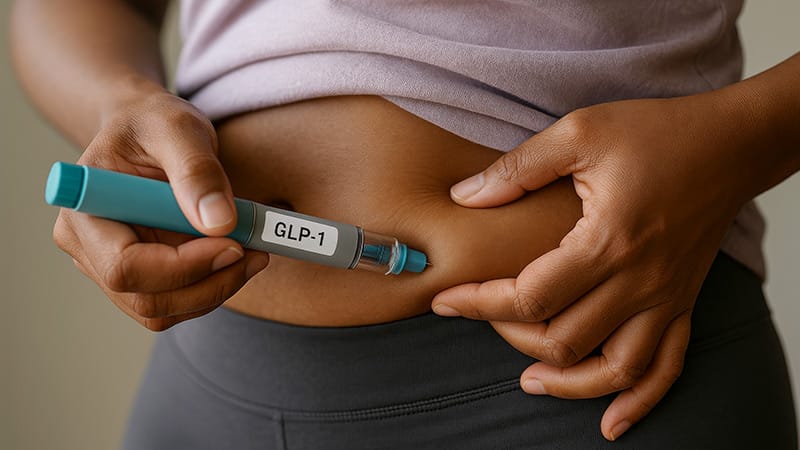
GLP-1 medications, which are used in particular as part of obesity management, have profoundly changed the approach to weight loss. For some people, they make it possible to achieve significant weight loss, sometimes after years of unsuccessful dieting and lifestyle changes.
But a question is increasingly emerging after this transformation: what can be done when the weight goes down, but the skin does not regain sufficient firmness?
This is one of the new challenges in body contouring. After significant weight loss, particularly when it occurs rapidly, some people notice loose skin around the abdomen, arms, thighs, back or breasts.
This situation has contributed to the emergence of a new concept in aesthetic surgery: post-weight-loss body contouring, which now also concerns patients who have lost weight through GLP-1 treatments.
Why Are GLP-1s Changing the Demand for Aesthetic Surgery?
GLP-1 treatments have changed the weight-loss journey for many people. Their use is associated with an increase in consultations with plastic surgeons among patients who have reached or are approaching their target weight. According to data from the American Society of Plastic Surgeons, 82% of surgeons surveyed in 2025 reported receiving inquiries related to the use of GLP-1 medications.
The aesthetic consequences therefore go beyond the issue of fat alone.
When body volume decreases significantly, the skin must adapt to a smaller body envelope. However, this adaptation depends on many factors: age, genetics, the amount of weight lost, the rate of weight loss, how long the person has been overweight, and tissue elasticity.
In some cases, the skin retracts sufficiently. In others, excess skin remains.
The issue then becomes different from that of someone who simply wants to eliminate a small amount of localized fat.
Weight Loss and Excess Skin: Why Is Liposuction Not Always Enough?
A common misconception is that liposuction can correct the entire silhouette after significant weight loss.
However, fat and skin are two different issues.
Liposuction can remove localized fat deposits and reshape certain areas when tissue quality is suitable for this approach. However, it cannot remove a significant amount of excess skin.
This is why the assessment should consider several factors:
- the amount of remaining fat;
- skin quality and elasticity;
- the extent of skin laxity;
- tissue distribution;
- weight stability;
- overall body shape;
- the patient’s aesthetic goals.
This distinction is essential after significant weight loss.
The right treatment is therefore not necessarily the one that removes the most fat, but the one that addresses the actual anatomical issue.
Post-GLP-1 Body Contouring: A New Aesthetic Journey
The term post-GLP-1 body contouring is increasingly used to describe the body-contouring needs that arise after weight loss associated with these treatments.
It is not a new single surgical procedure.
Rather, it is a way of approaching patient care after a major physical transformation.
Depending on the individual case, the surgeon may consider:
- abdominoplasty;
- circumferential abdominoplasty or a body lift;
- arm lift;
- thigh lift;
- back lift;
- breast surgery;
- complementary liposuction;
- or a combination of several techniques.
The choice depends entirely on the patient’s anatomy and the extent of skin laxity. In some cases, it may also be recommended to use aesthetic medicine treatments to address the side effects of weight-loss medications.
Which Areas Can Be Affected After Significant Weight Loss?
The Abdomen
The abdomen is one of the areas most frequently affected.
After significant weight loss, abdominal skin may form a fold or excess skin that does not disappear despite weight stabilization and regular exercise.
In this situation, abdominoplasty may be considered to remove excess skin and, when indicated, address certain associated muscle issues.
When several areas of the torso are affected, a more comprehensive approach may be necessary.
The Arms
A significant loss of volume can also leave loose skin along the inner part of the arms.
Exercise can improve muscle mass, but it does not always eliminate significant excess skin.
An arm lift may then be recommended when the degree of laxity goes beyond what can be corrected with non-surgical techniques.
The Thighs
The thighs can also develop excess skin after significant weight loss.
A thigh lift aims to remove excess skin and improve the contour of the area.
The indication depends in particular on the location of the laxity and the quality of the tissues.
The Back and Lower Body
Skin laxity can also affect the back, flanks, hips and buttock area.
In some situations, a body lift can be a particularly interesting approach. This procedure is traditionally used after massive weight loss to address excess skin across the torso and certain surrounding areas in a more comprehensive way.
Aram Clinic offers body lift treatment in Tunisia, particularly for patients with significant excess skin following weight loss.
Should You Wait Before Having Surgery After GLP-1 Treatment?
There is no single waiting period that applies to every patient.
Before considering surgery, the surgeon should determine whether the patient’s weight is sufficiently stable and whether their nutritional status is compatible with surgery.
This step is particularly important after significant weight loss.
Ongoing weight loss may continue to change the patient’s body shape and the amount of excess skin.
The consultation therefore helps determine the most appropriate time for surgery.
The goal is not simply to have reached a number on the scale, but to reach a sufficiently stable situation to plan body contouring consistently.
Why Is Nutritional Quality Important Before Surgery?
Rapid weight loss may be accompanied by changes in body composition and nutritional intake.
Before surgery, the surgeon may therefore recommend an appropriate medical and laboratory assessment to ensure that the patient has the necessary conditions for proper recovery.
Protein, certain vitamins and micronutrients play an important role in wound healing and recovery.
This is why an aesthetic surgery project following significant weight loss should never be considered solely an aesthetic project.
Medical preparation is an integral part of the outcome.
Surgery or Technology: How Do You Choose After Weight Loss?
Not every patient who has lost weight needs surgery.
When skin laxity is moderate and skin quality remains relatively good, certain skin-tightening technologies may sometimes be considered.
Radiofrequency, certain skin-retraction technologies and other non-invasive treatments may have a role in selected cases.
However, when significant excess skin is present, technology cannot always replace surgical excision.
The choice should therefore be individualized.
At Aram Clinic, this distinction is particularly important when assessing patients who wish to improve their silhouette after weight loss: technology when appropriate, surgery when excess skin justifies it, and sometimes a combination of both.
What About the Face After Significant Weight Loss?
The phenomenon does not only affect the body.
Significant weight loss can also change facial volume. Some people notice a loss of cheek volume, more pronounced folds or a more hollow appearance.
This phenomenon is sometimes referred to online as “Ozempic Face”.
A 2025 analysis based on Google Trends data showed a significant increase in interest in searches related to “Ozempic Face” between 2022 and 2025.
However, treatment does not necessarily involve adding volume.
The goal should be to understand which tissues have changed and why, and then choose an appropriate solution: aesthetic medicine, volume restoration, tissue stimulation or, in certain situations, surgery.
After GLP-1s, the Goal Is Not to “Redo” the Body
Post-weight-loss body contouring follows a different approach from that of a dramatic aesthetic transformation.
The patient has already undergone a significant transformation: they have lost weight.
Surgery can then aim to complete this transformation by removing tissues that have not adapted sufficiently.
Modern approaches therefore increasingly focus on:
- harmonious proportions;
- a natural-looking silhouette;
- consideration of the patient’s anatomy;
- correction adapted to each area;
- a comprehensive strategy rather than an accumulation of procedures.
This pursuit of natural and proportionate results is also part of a broader trend observed in aesthetic surgery in 2025: patients are increasingly seeking subtle, balanced and personalized results.
Can Several Procedures Be Combined After Weight Loss?
Yes. In some situations, several areas can be treated as part of the same surgical plan or over several stages.
For example, a person with significant abdominal laxity and localized fat accumulation may require a combination of techniques.
In other cases, it may be preferable to treat the areas progressively in order to limit operative time and promote appropriate recovery.
The strategy therefore depends on the patient’s overall health, the amount of skin to be removed, the areas involved and safety considerations.
Why Is a Personalized Consultation Essential?
Two people who have lost the same amount of weight can have completely different body shapes.
One may retain good skin elasticity and mainly require localized body contouring.
Another may have significant excess skin around the abdomen, arms, thighs and back.
It would therefore be overly simplistic to recommend a procedure based solely on the number of kilograms lost.
The consultation should make it possible to assess skin quality, tissue distribution, body shape, medical history, weight stability and the patient’s goals.
Post-GLP-1 Body Contouring: A New Step After Weight Loss
GLP-1 treatments have opened a new chapter in the management of obesity and weight loss. Their development is also bringing new aesthetic concerns among patients who have achieved significant weight loss.
The question is therefore no longer simply: “How can I lose weight?”
It is also becoming: “How can I support the body after significant weight loss?”
Post-GLP-1 body contouring is part of this evolution.
Depending on individual needs, it may combine body-contouring surgery, skin-retraction technologies and personalized medical care. The goal is not to artificially transform the body, but to restore a silhouette that is consistent with the patient’s new body shape.
At Aram Clinic Tunisia, each project is assessed individually to determine the techniques best suited to the patient’s profile and goals.