

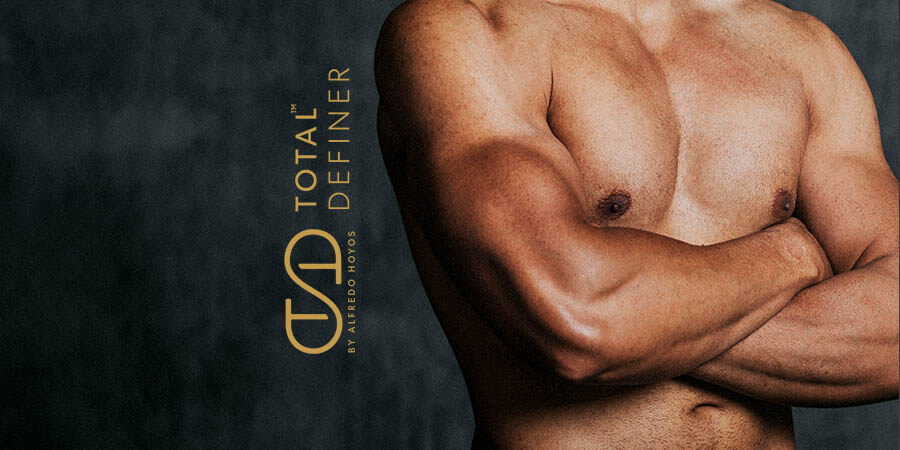
The quest for a harmonious figure is no longer limited to reducing fat deposits. Today, cosmetic body surgery also focuses on defining muscular contours, achieving balanced proportions and enhancing the body’s natural anatomy. High-definition liposculpture forms part of this approach, particularly when combined with the techniques developed by the Total Definer programme.
At Aram Clinic Tunisia, body contouring is based on a personalised analysis of body shape, fat distribution and skin quality. The aim of high-definition liposculpture is to work precisely on volumes in order to highlight certain muscular contours, whilst striving for a result that is consistent with the patient’s figure.
But what exactly does the Total Definer involve? Which areas can be treated, what results can be expected, and who is this approach aimed at?
What is the Total Definer in cosmetic surgery?
The term ‘Total Definer’ refers to an international training and certification programme dedicated to advanced high-definition liposculpture techniques, founded by the plastic surgeon Dr Alfredo Hoyos, a pioneer of High Definition Liposculpture (HD Lipo).
In everyday language, the term is also used to describe an approach to body contouring aimed at accentuating muscle definition and improving the silhouette’s contours. However, it is important to distinguish between the Total Definer programme itself and the surgical techniques of high-definition liposculpture that it teaches.
Unlike conventional liposuction, the main aim of which is to reduce localised fat deposits and refine the contours, high-definition liposculpture involves a more selective treatment of fatty tissue. The surgeon tailors the treatment areas and depths to highlight existing anatomical lines.
This approach may, in particular, seek to emphasise:
- The contours of the abdominal muscles.
- The waistline and the obliques.
- The contours of the back and flanks.
- Certain muscular lines of the chest in men.
- The transitions between different areas of the body to achieve a balanced result.
The fundamental principle remains respect for individual anatomy. The technique does not create muscles that do not exist: it seeks to better reveal the underlying contours by selectively reducing the fat that masks them.
How does high-definition liposculpture work?
High-definition liposculpture combines an in-depth knowledge of surface anatomy with targeted suction of fatty tissue. The surgeon does not simply aim to remove a uniform volume of fat, but to gradually sculpt the body’s contours.
1. A precise analysis of body shape
Before the procedure, the surgeon assesses the patient’s figure, fat distribution, muscle development, skin elasticity and expectations.
This stage helps to determine which areas can be refined, which contours should be emphasised, and the degree of definition compatible with a natural appearance.
2. Selective fat removal
Liposculpture is carried out at different depths, depending on the anatomical objectives. Certain areas may be further refined to emphasise muscle definition, whilst others retain sufficient fat volume to maintain harmonious transitions.
This precision requires a high level of technical skill. Excessive or uneven fat removal can lead to irregularities, overly pronounced hollows or an unnatural appearance.
3. Technologies tailored to the surgical procedure
Depending on the indication and the equipment used, liposculpture may involve various techniques, notably ultrasound-assisted liposuction, such as VASER.
This technology uses ultrasound energy to facilitate the separation of fatty tissue prior to its removal. It can be useful in certain high-definition contouring procedures, but it is no substitute for the surgeon’s experience or the rigorous selection of patients.
The choice of technique depends on the area to be treated, the amount of fat, the quality of the skin and the desired outcome.
Which areas of the body can be contoured using the Total Definer?
High-definition liposculpture can be performed on various areas of the body. The surgical plan is tailored to each patient and does not necessarily involve treating the whole body.
The abdomen: revealing muscle definition
The abdomen is one of the main areas for which high-definition liposculpture is indicated. By targeting subcutaneous fat, the surgeon can aim to make the lines of the abdominal muscles more visible.
For some patients, the aim is to achieve a subtle, athletic definition. For others, a more pronounced definition may be considered, provided their body shape and musculature are suitable.
The result depends in particular on muscle development, the thickness of the subcutaneous fat and the elasticity of the skin.
The waist and flanks: refining the contours
Overall waist contouring aims to reduce certain pockets of fat and improve the transition between the abdomen, flanks and back.
This approach can help accentuate the difference between the waist and the hips, particularly for those seeking a more defined silhouette.
For patients seeking an hourglass figure, liposculpture can sometimes form part of a more comprehensive plan involving several areas of the body. However, the suitability of combining it with other techniques must be assessed on a case-by-case basis.
The back: harmonising the body’s contours
Fat deposits on the back can alter the contours of the figure, particularly around the flanks and the lower back.
Targeted liposculpture can help to refine these areas and improve the continuity of the body’s contours. The aim is to achieve a natural transition between the back, waist and hips, rather than creating excessively pronounced indentations.
The male chest: emphasising the pectoral contours
For some men, high-definition liposculpture may be considered to improve the definition of the chest and highlight the pectoral contours.
A medical assessment remains essential to distinguish excess subcutaneous fat from true gynaecomastia, which may involve enlargement of the mammary gland and require a different course of treatment.
Total Definer and conventional liposuction: what are the differences?
Both approaches involve the surgical removal of fat, but they do not pursue exactly the same objective.
| Criterion | Conventional liposuction | High-definition liposculpture |
| Main objective | To reduce localised fat deposits | To refine contours and highlight certain muscular features |
| Aspiration strategy | Reduction and evening out of volumes | Selective work at different depths |
| Desired result | A slimmer silhouette and harmonious contours | A more sculpted silhouette, with appropriate muscle definition |
| Typical candidate | Patients with stubborn pockets of fat | Patients close to their target weight, with favourable musculature and skin quality |
| Level of precision | Depends on the area and the technique used | Requires a particular mastery of superficial anatomy |
High-definition liposculpture is therefore not necessarily superior to conventional liposuction. The choice depends on the actual need: a uniform reduction in volume may be more appropriate than pronounced muscle definition in certain patients.
Who is a suitable candidate for high-definition liposculpture?
The Total Definer and high-definition liposculpture techniques are not suitable for everyone. Patient selection plays a vital role in the quality of the result and the management of risks.
Potential candidates generally share several characteristics:
- A relatively stable weight, close to their target weight.
- Localised fat deposits that are resistant to a balanced diet and physical activity.
- Sufficiently developed musculature so that its contours can be accentuated.
- Skin with sufficient elasticity to accommodate the planned reshaping.
- Realistic expectations regarding the degree of definition and post-operative recovery.
Conversely, this approach may be less suitable in cases of significant excess skin, marked abdominal laxity or a large amount of visceral fat. Liposuction primarily targets fat located beneath the skin and does not directly remove the visceral fat surrounding the organs.
In cases of severely stretched skin, a procedure to remove excess skin, such as a tummy tuck, may be more appropriate. The decision is based on a clinical examination and an in-depth discussion with the surgeon.
What results can be expected from Total Definer?
The desired result is a more defined silhouette, with more visible muscle contours and smooth transitions between the different treated areas.
However, the result varies depending on several factors:
- The initial body shape and fat distribution.
- Muscle development.
- The quality and elasticity of the skin.
- The surgical technique chosen.
- The healing process and the resolution of oedema.
- Weight stability following the procedure.
It is important to understand that liposculpture is not a substitute for regular physical activity and is not a method of weight loss. It is used to modify certain body contours when the anatomical conditions are favourable.
The first changes may be visible after the procedure, but post-operative swelling may temporarily mask the desired definition. The result develops gradually as the area heals, over a period of several weeks to several months.
Maintaining a stable weight and healthy lifestyle habits help to preserve the achieved contours. A significant change in weight may alter the result.
How is a high-definition liposculpture procedure carried out?
The pre-operative consultation
The first step involves assessing the patient’s state of health, their medical and surgical history, any treatments they are currently undergoing, and their aesthetic goals.
The surgeon examines the areas concerned and determines whether high-definition liposculpture is appropriate. They also explain the limitations of the technique, any potential risks and alternative options.
A pre-operative assessment is then arranged in accordance with medical protocol and the patient’s individual circumstances.
The surgical procedure
The procedure is carried out under anaesthesia appropriate to the extent of the treatment and the patient’s medical circumstances. Small incisions are made to insert the cannulas required for fat removal.
The surgeon performs the contouring, taking into account the anatomical contours, the thickness of the tissues and the objectives defined prior to the operation.
The duration of the operation depends on the number of areas treated, the complexity of the contouring and whether it is combined with other procedures.
Post-operative care
After the operation, swelling, bruising, local tenderness and a feeling of tightness may occur. The severity of these symptoms varies depending on the patient and the extent of the surgical procedure.
Wearing a compression garment may be prescribed to aid recovery. Aftercare, mobility, resuming daily activities and returning to sport are organised in accordance with the surgeon’s instructions.
Medical follow-up is essential to monitor healing and quickly identify any complications.
What are the risks and limitations of this technique?
Like any surgical procedure, high-definition liposculpture carries risks. These may include bleeding, infection, seroma, contour irregularities, asymmetry, temporary or persistent sensory disturbances, and complications related to anaesthesia.
Depending on the technique used, thermal injuries may also occur during ultrasound-assisted liposuction. More rarely, serious complications, particularly thromboembolic events, are possible.
The pursuit of pronounced muscle definition requires particular care: excessive suction can produce artificial contours, accentuate skin irregularities or compromise the overall harmony of the figure.
The choice of surgeon, pre-operative assessment, adherence to indications and post-operative follow-up are therefore essential elements of patient care.
No single technology can guarantee a perfect result or the absence of complications on its own. A medical consultation allows the expected benefits to be weighed against individual risks.
Why consider high-definition liposculpture in Tunisia with Aram Clinic?
Choosing a body contouring procedure involves considering far more than just the technique used. The quality of the medical assessment, the suitability of the surgical plan, the safety of the care provided and post-operative follow-up are all crucial factors.
Aram Clinic Tunisia supports patients throughout their cosmetic surgery journey, taking into account their goals and body type. For a request for high-definition liposculpture, the assessment must focus in particular on the areas to be treated, the desired level of definition, the condition of the skin and any anatomical limitations.
The care pathway may include reviewing medical records, organising the stay and coordinating the various stages, depending on the services agreed with the team.
Before choosing a technique, it is essential to check its actual suitability and to prioritise a personalised plan over a standardised result.
Would you like to reshape your figure? An initial assessment of your plan can help determine whether traditional liposuction, high-definition liposculpture or another body contouring approach best meets your expectations.
FAQs about Total Definer
What is the difference between Total Definer and VASER?
Total Definer is a training and certification programme dedicated specifically to high-definition liposculpture. VASER is an ultrasound-assisted liposuction technology. The two concepts are therefore different, even though VASER may be used in certain high-definition liposculpture procedures.
Does Total Definer help to achieve visible abdominal muscles?
High-definition liposculpture can make the contours of the abdominal muscles more visible when the musculature is sufficiently developed and the subcutaneous fat layer allows for it. It does not create muscles and does not guarantee a precise abdominal definition in all patients.
Is this procedure suitable for women?
Yes, high-definition liposculpture can be considered for both women and men. However, the surgical plan must take into account the patient’s body shape, proportions and the desired outcome. A very pronounced muscular definition is not necessarily the intended goal.
Does the Total Definer help with weight loss?
No. High-definition liposculpture is primarily aimed at reshaping localised areas. It is not intended to treat obesity or to replace a comprehensive weight management programme.
Are the results permanent?
Not all of the removed fat cells are replaced in the same areas, but the remaining cells may increase in volume if weight is gained. Skin ageing and weight fluctuations can also alter the contours of the figure.
How long does it take to see the final result?
An improvement in contours may become apparent gradually after the procedure. However, swelling and healing will affect the appearance of the figure for several weeks, or even several months. The timeframe depends on the extent of the treatment and the individual’s recovery.
Can Total Definer be combined with other procedures?
Certain combinations of surgical procedures may be considered where there is a valid medical indication and the patient’s health permits it. These must be assessed on a case-by-case basis, taking into account the duration of the operation, the cumulative risks and the recovery conditions.
How do I know if I am a suitable candidate for high-definition liposculpture?
A consultation with a qualified plastic surgeon is essential. This allows for an assessment of fat distribution, musculature, skin quality, medical history and aesthetic expectations in order to determine the most appropriate approach.